

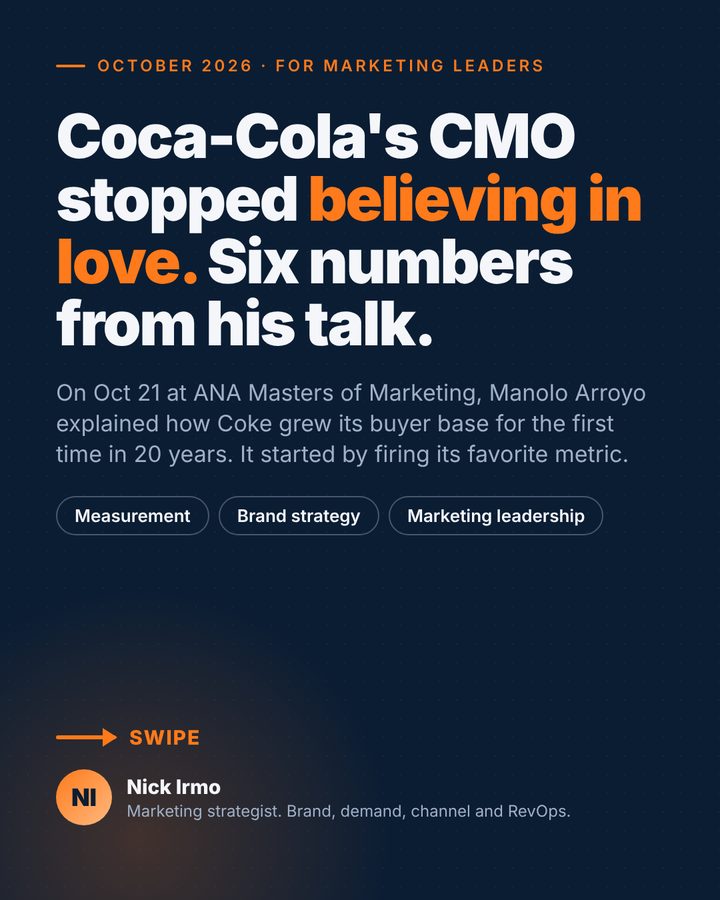
Coca-Cola’s global CMO said this week that he no longer believes in love. Not a breakup. A KPI.
On October 21 at ANA Masters of Marketing, Manolo Arroyo walked through what he found when he took over global marketing in 2020. For roughly twenty years the lead marketing metric had been “brand love,” a perception score. It kept going up. Business performance did not. Marketing pointed at the score, sales pointed at the volume, and the argument never ended because neither side was lying. His words, as reported by Marketing Dive and Marketers & Money: “I do not believe anymore in love.”
What Coke did next is the useful part, because it is a pattern any marketing leader can copy at any size. Here are the six numbers from the talk, and what I would do with each.
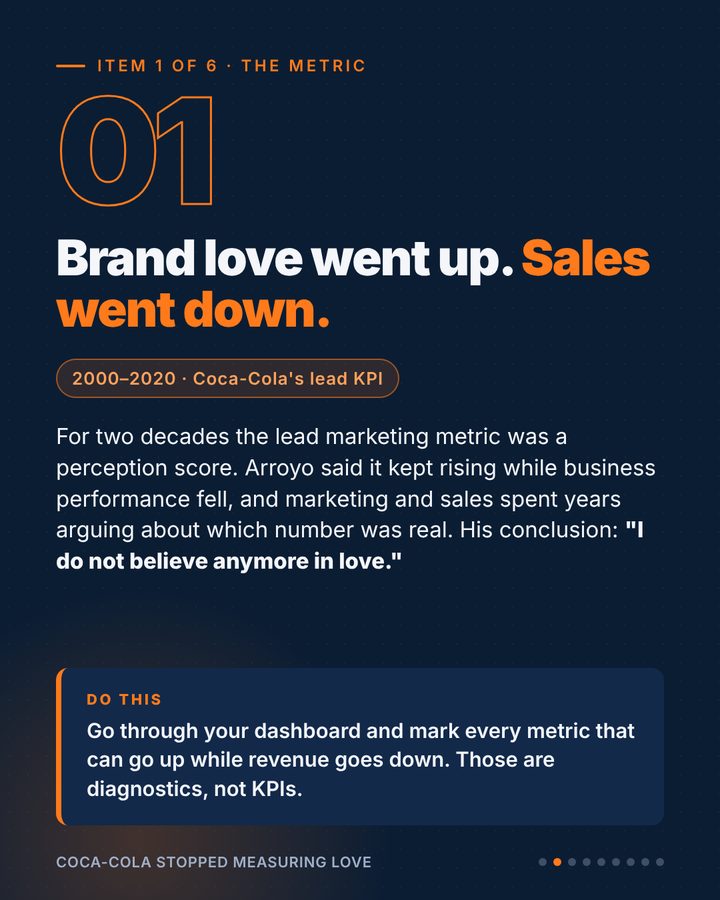
1. Brand love went up. Sales went down.
For two decades the headline metric could rise while the business fell. That is the definition of a diagnostic, not a KPI. Do this: go through your dashboard and mark every metric that can go up while revenue goes down. Awareness, sentiment, engagement, followers, and MQLs if your qualification is loose. Keep them, but move them out of the top row.
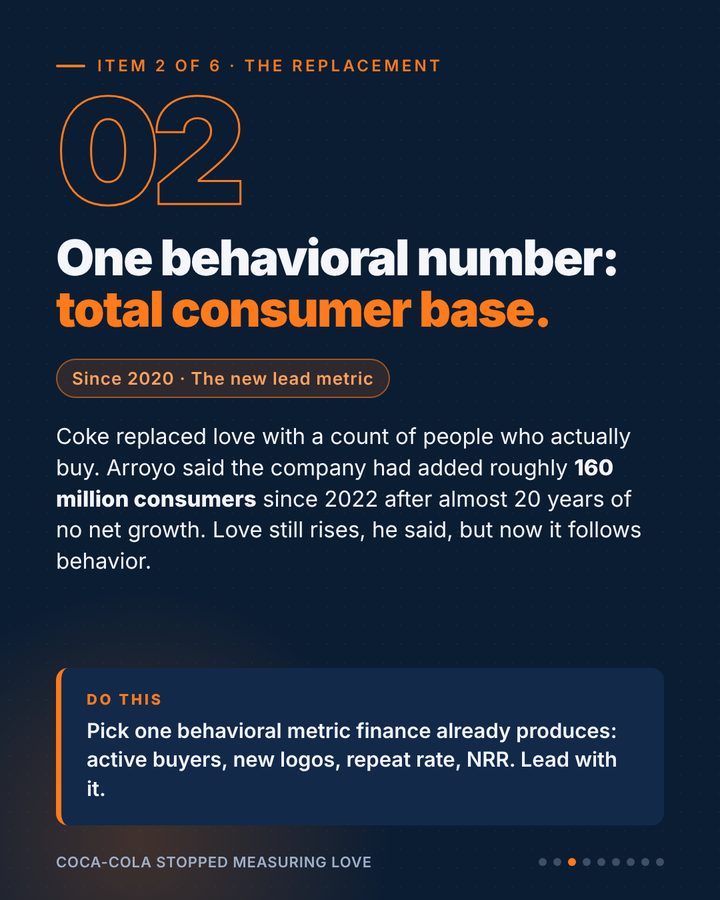
2. One behavioral number: total consumer base
Coke replaced love with a count of people who actually buy. Arroyo said the company has added roughly 160 million consumers since 2022, after almost twenty years of no net growth. Love still rises, he said, but now it follows behavior. Do this: pick one behavioral metric finance already produces, such as active buyers, new logos, repeat rate or net revenue retention, and lead with it.
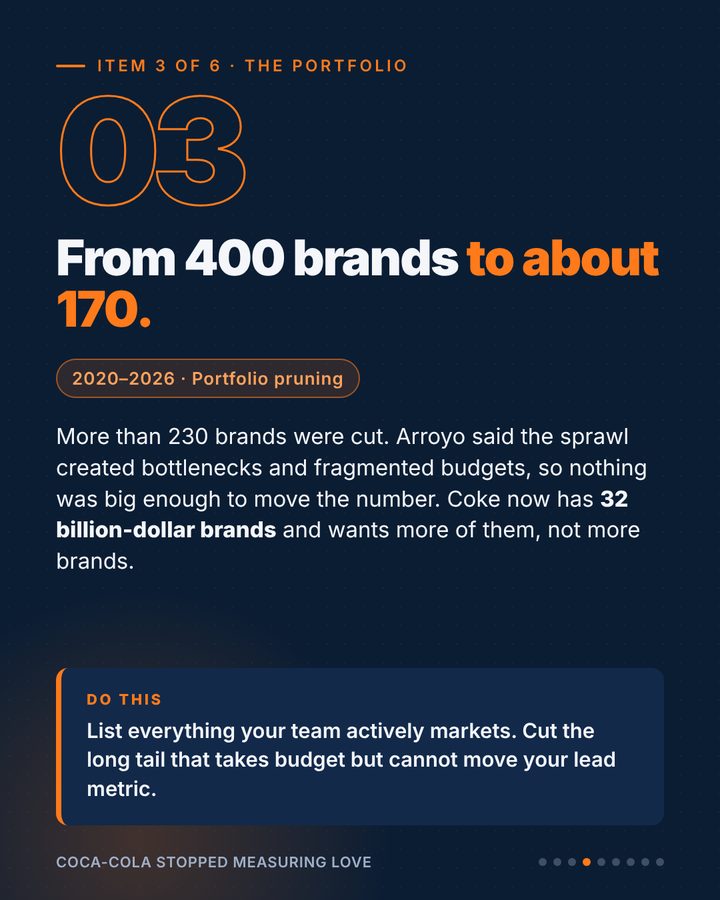
3. From 400 brands to about 170
More than 230 brands were cut. The sprawl, Arroyo said, created bottlenecks and fragmented budgets, so nothing was big enough to move the number. Coke now has 32 billion-dollar brands and wants more of those, not more brands. Do this: list everything your team actively markets and cut the long tail that takes budget but cannot move your lead metric.
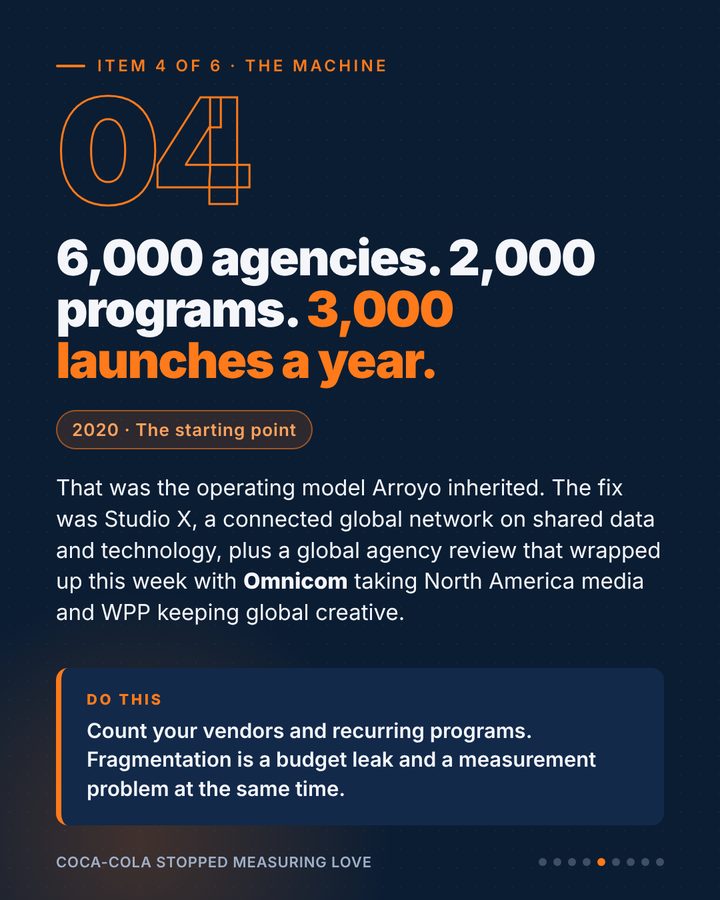
4. 6,000 agencies, 2,000 programs, 3,000 launches a year
That was the operating model he inherited in 2020. The fix was a connected global network on shared data and technology, and a global agency review that concluded this week. Do this: count your vendors and recurring programs. Fragmentation is a budget leak and a measurement problem at the same time.
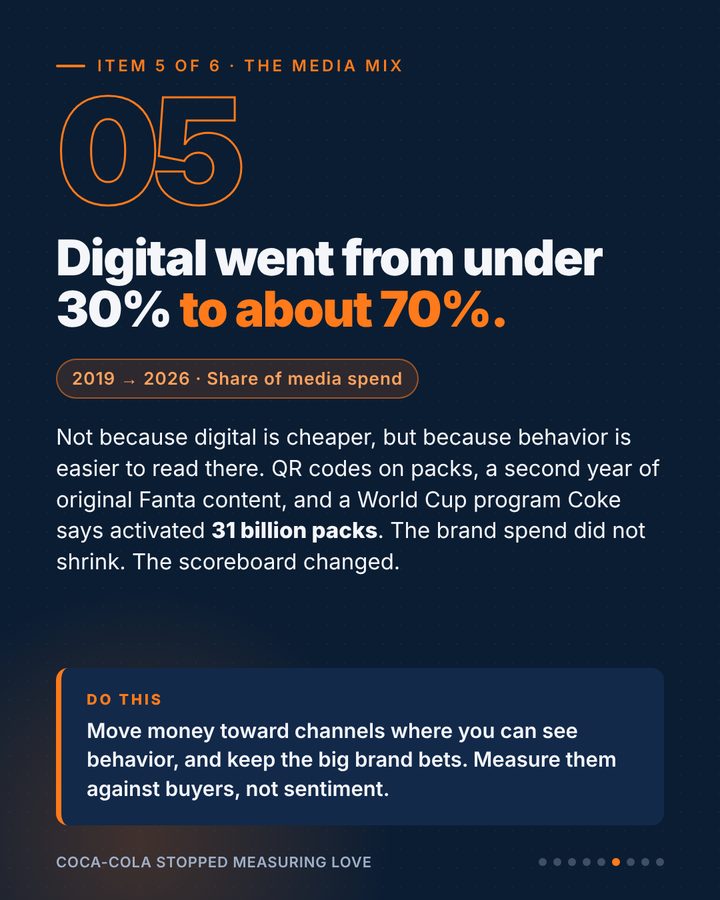
5. Digital went from under 30% of media to about 70%
Not because digital is cheaper, but because behavior is easier to read there: QR codes on packs, original content, a World Cup program the company says activated 31 billion packs. The brand spend did not shrink. The scoreboard changed. Do this: move money toward channels where you can see behavior, keep the big brand bets, and measure them against buyers rather than sentiment.
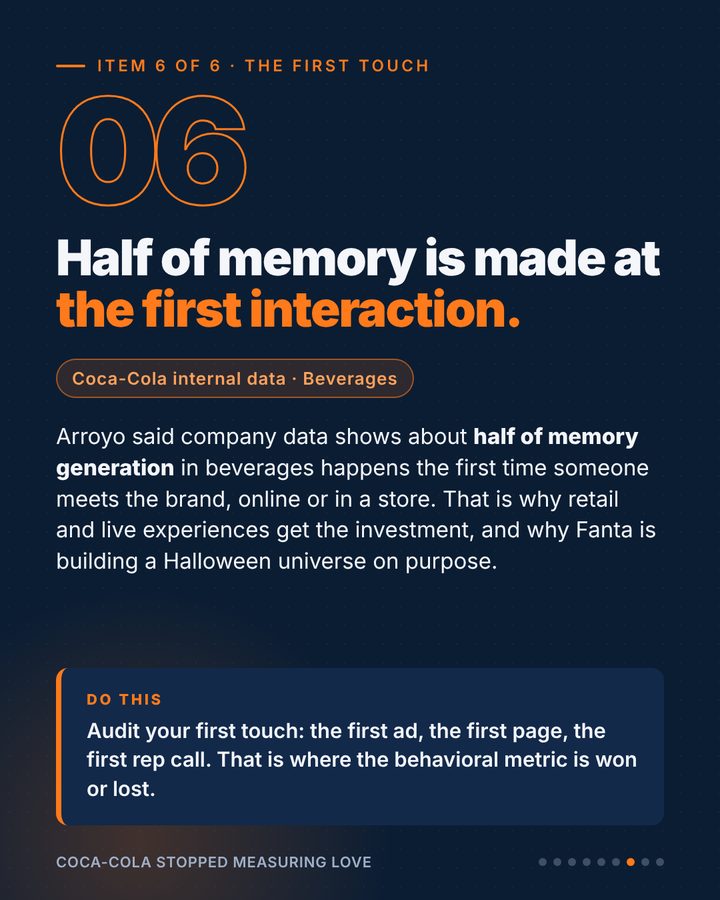
6. Half of memory is made at the first interaction
Arroyo said company data shows about half of memory generation in beverages happens the first time someone meets the brand, online or in a store, which is why retail and live experiences get the investment. Do this: audit your first touch, meaning the first ad, the first page and the first rep call. That is where the behavioral metric is won or lost.
The pattern, and the part people will get wrong
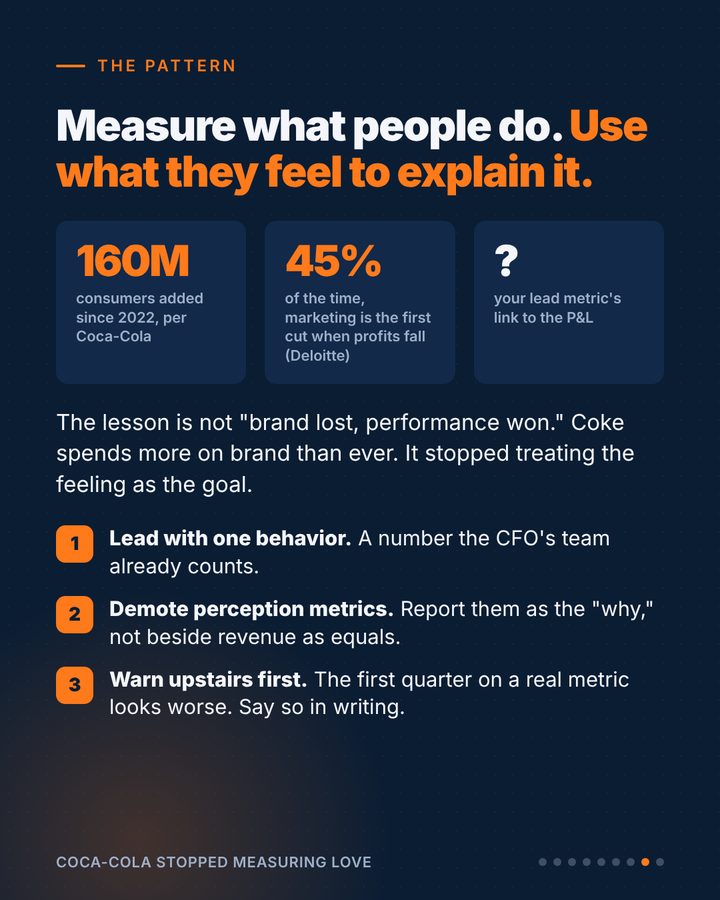
The lesson is not “brand lost, performance won.” Coke is spending more on brand than it ever has. What changed is that the feeling stopped being the goal and became the explanation. Measure what people do; use what they feel to explain it.
It matters more than it used to. Deloitte Digital’s new CMO report, as covered by LBB Online, found that marketing is the first budget cut 45% of the time when profits fall. A dashboard that leads with a perception score is the easiest one in the building to cut.
The four moves, in order
- Lead with one behavior: a number the CFO’s team already counts.
- Demote perception metrics: report them as the “why” under that number, not beside it as equals.
- Warn upstairs first: the first quarter on a real metric looks worse than the last quarter on a flattering one. Say so in writing before you switch.
- Re-run the test every budget season, because new flattering metrics grow back.
I have made this switch at a mortgage lender and a PEO, and the first conversation was uncomfortable both times. It was also the conversation that got marketing a seat in the pipeline review instead of a slide at the end of it.
Sources: Marketing Dive, Oct 23, 2026; Marketers & Money, Oct 21, 2026; MediaPost Marketing Daily, Oct 22, 2026; LBB Online on Deloitte Digital’s “Remarketing Marketing,” Oct 21, 2026. All Coca-Cola figures are the company’s own, presented at ANA.
Measure what people do. Use what they feel to explain it. Lead with one behavioral number finance already produces, and demote perception metrics to the “why.”